Fox Ledger / Entries / Methods
Cash basis or traditional accounting, and do you need double entry?
Posted by the editors. Figures stated by tax year.
From the 2024 to 2025 tax year, cash basis is the default for sole traders: you record income when it arrives and expenses when you pay them. Traditional accounting records them by the date you invoiced or were billed. Neither method requires double-entry books. Most very small businesses can stay on cash basis, but stock-heavy firms and those seeking finance may have reason to opt out.

One invoice, two answers
The difference shows clearly when an invoice straddles the end of the tax year. Suppose a sole trader invoices £2,000 on 20 March 2027 and the customer pays on 15 April 2027. The tax year ends on 5 April 2027 in between.
| Method | Date that counts | 2026 to 2027 (£) | 2027 to 2028 (£) |
|---|---|---|---|
| Cash basis | 15 April 2027, when paid | 0.00 | 2,000.00 |
| Traditional | 20 March 2027, when invoiced | 2,000.00 | 0.00 |
Under cash basis you do not pay Income Tax on money you have not yet received. That is the main attraction, and it is a real one if your customers pay slowly. GOV.UK's guide adds a useful detail: you can choose when you treat money as received, such as when it reaches your account or when a cheque is written, as long as you use the same approach for each return.
What each method asks you to keep
Cash basis is lighter because the bank and your receipts tell most of the story. Traditional accounting means more records: money owed to you, bills committed but unpaid, stock and work in progress at the period end, and year-end bank balances, on top of what we list in our records guide.
Equipment is the other big difference. Under cash basis, machinery, computers and vans generally count as normal allowable expenses in the year you pay for them. Traditional accounting uses capital allowances. A car bought for the business is claimed through capital allowances either way, unless you are using the simplified mileage rates for it. The rest of the sorting is in what sole traders can claim.
VAT-registered traders on cash basis can record income and expenses with or without VAT, provided both are treated the same way. If you include VAT, then VAT paid to HMRC is an expense and a refund from HMRC is income.
Three questions that usually settle it
Are you allowed cash basis at all?
Sole traders and partnerships without corporate partners can use it. The exclusions include limited companies and limited liability partnerships, Lloyd's underwriters, farming businesses with a herd basis election, farming or creative businesses with a profit averaging claim, and a few others such as mineral extraction. A limited company is therefore outside this choice altogether. If you have two separate businesses, you can choose for each one.
Is the business complicated, or stock-heavy?
GOV.UK names high levels of stock as a situation where traditional accounting may suit better. Think of a shop that buys a year's worth of goods in February. On cash basis that spending lands all at once. Traditional accounts carry unsold stock forward, which can give a truer picture of how the year went.
Will someone else read your accounts?
The same page notes that a bank may ask for accounts drawn up under traditional accounting if you need finance. Some specialised trades also rely on calculation rules that are not available on cash basis, and GOV.UK lists them.
If you choose traditional accounting, or have to use it, say so on your Self Assessment return. Moving between methods may require adjustments, so it is one of the better moments to pay for an hour of an accountant's time.
So where does double entry come in?
The cash basis and traditional accounting labels describe when an item counts. Double entry describes how it gets written down. The two are separate questions, and the GOV.UK pages on self-employed records cited here ask for accurate records without naming a format. A sole trader can file on the strength of a simple list of money in and money out.
Double entry records each transaction twice, once on the debit side of one account and once on the credit side of another. So a £240 sale paid into the bank looks like this:
| Dr. (£) | Cr. (£) |
|---|---|
| 240.00 |
| Dr. (£) | Cr. (£) |
|---|---|
| 240.00 |
The appeal is the built-in check. If all the debits and credits do not agree, there is a mistake somewhere, and you know it before the return is due. It also shows at a glance what you owe and what is owed to you, which a list of bank movements cannot. Bookkeeping software usually does this behind the screen, so you may already be using it without having drawn a ruled line.
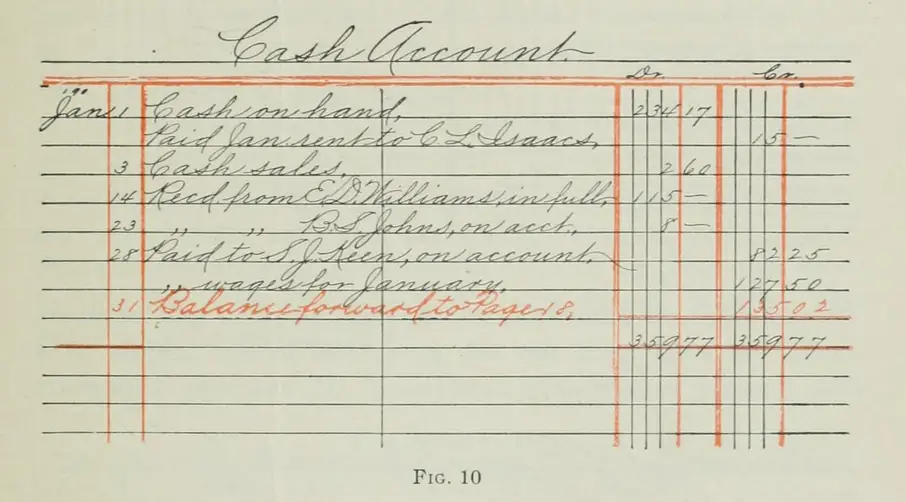

For a one-person firm with a dozen transactions a month, a tidy cash book is often all that is needed. Once you carry stock, take on credit customers or plan to borrow, a double-entry system starts to earn its keep. Those are also the businesses more likely to be on traditional accounting, which is why the two tend to get muddled.
The practical upshot
Doing nothing leaves you on cash basis, as long as your business is allowed it. Your choice does not change the rates of tax, and it does not move your filing dates, which we set out in the Self Assessment calendar. It can change which tax year a profit falls in, and that may matter if your income swings from year to year. For a decision with that kind of knock-on effect, a qualified accountant who has seen your figures is the right person to ask.
General education, not personal advice. Links in this article go to the GOV.UK pages we read while writing it, opened again on 8 November 2026. Rates and rules change, so check the current figure on GOV.UK before relying on it.